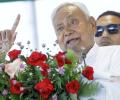
Bihar Chief Minister Nitish Kumar has resigned, dissolving his cabinet and paving the way for a potential BJP-led government in the state. The BJP, the largest party in the assembly, is set to elect its legislature party leader.

Bihar Deputy Chief Minister Samrat Choudhary has been elected as the BJP legislature party leader, paving the way for him to become the next Chief Minister of Bihar.

The Bharatiya Janata Party Parliamentary Board on Monday appointed party national general secretary Tarun Chugh as the central observer for the election of the legislature party leader in Manipur, indicating the possible formation of a popular government in the Northeastern state.

The BJP will focus on Prime Minister Narendra Modi's development agenda in the upcoming West Bengal assembly elections, rather than projecting a chief ministerial candidate, according to state BJP president Samik Bhattacharya.

There is no cause for concern, as the overall situation arising out of the crisis is firmly under control, the Centre informed while briefing political parties at the all-party meet.

The Comptroller and Auditor General of India (CAG) has reported significant financial irregularities in the Union government's FY25 accounts, including ~12,754.47 crore in misclassification and ~54,282.32 crore in outstanding utilisation certificates, with some dating back to 1985-86.

Senior BJP leaders, including Amit Shah and J P Nadda, met with party leaders and allies to discuss the upcoming Bihar polls. Seat-sharing arrangements with NDA partners are expected to be announced soon.

'Let's hope all other Kuki-Zo MLAs are also on the same page. But I will not be a part of this government unless our demands are met.'

'The move to appoint a person with a profile, markedly lower than the leader Nitin Nabin will replace, has the potential to put the brakes on the careers of several others in the party and government in the positions they currently hold,' points out Nilanjan Mukhopadhyay.
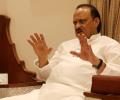
'We have given riot-free Maharashtra in our 18-month rule.'

Three laws passed in Parliament could boost central revenues, reshape GST cess flows, shift MGNREGA costs to states and create new budget headroom ahead of the 2026-2027 Union Budget, points out A K Bhattacharya.

The Delhi High Court has asked the central government why it cannot reduce the GST on air purifiers, considering the poor air quality in Delhi. The court's concern is that the current 18% GST makes air purifiers unaffordable for the common man.

Sonia Gandhi criticizes the Modi government's environmental policies, claiming they endanger the Aravalli hills and disregard environmental protection.
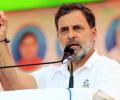
Democracy in India is too important to be left to a leader with a limited appeal. If Rahul Gandhi cares for India, he should step aside for a new crop of leaders, suggests Harishchandra.
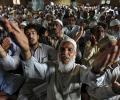
The All India Muslim Personal Law Board (AIMPLB) has announced its intention to challenge the Waqf (Amendment) Bill in court, labeling it a "black law" that threatens the community's rights. The AIMPLB, a major organization representing Muslims in India, asserts that the Bill, if passed, would lead to the seizure of Muslim properties and undermine the autonomy of Waqf Boards. The organization plans to launch nationwide protests against the Bill, echoing the farmers' agitation, and has urged all citizens to resist the legislation. The Bill has been met with criticism from various quarters, including opposition parties, who claim that the Centre is rushing it through Parliament without adequately addressing concerns raised by the Joint Parliamentary Committee (JPC).

Karnataka Cooperation Minister K N Rajanna has been asked to resign after allegedly blaming his own Congress government for 'vote theft' in an Assembly segment. The issue sparked controversy and led to demands for clarification in the state assembly.
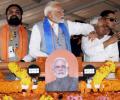
Only in the event of the RSS managing to force Modi into accepting a consensual candidate, will the party not continue to 'being' the 'next Congress', observes Nilanjan Mukhopadhyay.

Senior Haryana police officer Y Puran Kumar was found dead with a gunshot wound at his Chandigarh home. Police suspect suicide. He was the inspector general, Police Training Centre, in Sunaria, Rohtak.

CPGRAMS -- an online platform available to citizens 24x7 to lodge their grievances to public authorities on service delivery -- has existed for close to two decades. But it has never been this active, points out Tamal Bandyopadhyay.

Glimpses from India and around the world that will make you smile and cry.

Parliamentary Affairs Minister Kiren Rijiju feels that the National Sports Governance Bill, which is set to be tabled in the monsoon session beginning on Monday, will usher in a 'new era' for sports in India.

Sports Minister Mansukh Mandaviya said the Sports Bill is a key reform aimed at building a "transparent, accountable and world-class sports ecosystem" in India.

The bill to amend the law governing Waqf boards proposes far-reaching changes in the Wakf Act, 1995, including ensuring the representation of Muslim women and non-Muslims in such bodies.

'The Railways is today running train services with 30% less number of loco pilots.'

In its draft policy released last month, the CBSE had proposed conducting Class 10 board exams twice in an academic year from 2026.
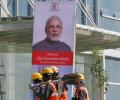
The Gujarat Bharatiya Janata Party on Thursday announced that Chief Minister Narendra Modi will contest elections from one seat in the state, without ruling out the possibility that he may fight on a second seat from Uttar Pradesh.

Asserting that there is "no race" for prime ministership in his party, Bharatiya Janata Party president Rajnath Singh has said that the decision in this regard would be taken by the central parliamentary board -- the highest decision making body of the party.
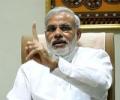
The Bharatiya Janata Party National Council on Saturday authorised newly-elected party president Rajnath Singh to constitute his parliamentary board, which may see Narendra Modi being formally brought to the party's central polity.
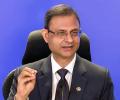
Reserve Bank Governor Sanjay Malhotra on Saturday said that the market forces decide the value of rupee with respect to the US dollar and the central bank is not worried about day-to-day movement of the currency value.

After a meeting of its working committee in New Delhi, the board adopted a resolution which stated that the recent judgment of the Supreme Court on the maintenance of Muslim divorcee women is "against the Islamic law (Shariah)".

The Centre on Wednesday told the Supreme Court that nobody can claim right over government land and it is legally empowered to reclaim properties which are declared waqf by using the waqf by user principle.

The Supreme Court of India began hearing a batch of petitions challenging the constitutional validity of the Waqf (Amendment) Act, 2025. The bench, led by Chief Justice Sanjiv Khanna, asked both sides to address whether the court should entertain the petitions or relegate them to the high court. The hearing is underway with senior advocate Kapil Sibal arguing for the petitioners. The act, which was passed by Parliament following heated debates, has been challenged by various parties including AIMIM leader Asaduddin Owaisi, All India Muslim Personal Law Board (AIMPLB), and Jamiat Ulama-i-Hind.
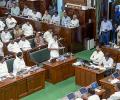
The Tamil Nadu Assembly passed a resolution on Thursday condemning the Centre's proposed Waqf Amendment Bill 2024, calling for its recall. Chief Minister M K Stalin argued that the amendment interferes with religious affairs and would negatively impact the Muslim minority. The resolution was unanimously passed by the Assembly, with support from all parties, including the opposition AIADMK and PMK. The BJP, however, walked out in protest, accusing the ruling DMK of engaging in divisive politics. The bill aims to streamline the Waqf Board's work and ensure efficient management of Waqf properties but has been criticized for potentially encroaching on religious freedom and autonomy. The Tamil Nadu government claims that the amendment would lead to government control over the Waqf Board and its properties, impacting its autonomy and potentially allowing for government acquisition of Muslim-owned lands.

A three-judge Supreme Court bench will hear petitions challenging the constitutional validity of the Waqf (Amendment) Act, 2025, on April 16. The petitions, including those by politicians and the All India Muslim Personal Law Board (AIMPLB) and Jamiat Ulama-i-Hind, were filed in the top court challenging the validity of the newly-enacted law. The Centre has filed a caveat in the apex court, seeking a hearing before any order is passed.
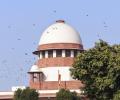
The Indian government defended the Waqf (Amendment) Act, 2025 in the Supreme Court, arguing that waqf, while an Islamic concept, is not an essential part of Islam. Solicitor General Tushar Mehta stated that waqf is essentially charity, which is recognized across religions, and cannot be considered a fundamental tenet of any faith. He also argued that the amended law addresses secular aspects of waqf and activities unrelated to Islam, and that "waqf by user" does not grant ownership of public land. Mehta highlighted the extensive consultations involved in the bill's creation, including feedback from various stakeholders. The hearing will continue on Thursday.
Gujarat Chief Minister Narendra Modi appears set for a bigger role at the national level in the Bharatiya Janata Party ahead of the next Lok Sabha polls, with the party on Sunday re-inducting him into the Central Parliamentary board, its top decision-making body.
Gujarat Chief Minister Narendra Modi appears set for a bigger role at the national level in the Bharatiya Janata Party ahead of the next Lok Sabha polls, with the party on Sunday re-inducting him into the Central Parliamentary board, its top decision-making body.

A large number of medical device-manufacturing units have been forced to move to Vietnam and Malaysia due to delays, inconsistent timelines, and a lack of transparency in licensing processes, according to the Parliamentary Standing Committee on Health and Family Welfare.

Indo-Canadian Anita Anand and Delhi-born Kamal Khera are part of new Canadian Prime Minister Mark Carney's cabinet. Anand is the Minister of Innovation, Science and Industry while Khera is Minister of Health. Carney's cabinet with 13 men and 11 women is smaller than Trudeau's 37-member team.

Hours after he resigned as Haryana chief minister along with his cabinet ministers, senior Bharatiya Janata Party leader Manohar Lal Khattar Tuesday hinted that he may be fielded by the party in the coming Lok Sabha polls.
 © 2026 Rediff.com - Advertise with us - Disclaimer - Privacy Policy - Sitemap - Feedback - About us - Terms of use - Grievances